November 15, 2026
We build AI quoting software, so you would expect us to say every agency needs it. Not every agency does. Some agencies will get hours back every day. Others would be paying for something that solves a problem they do not have.
This page helps you tell which one you are before you spend thirty minutes on a call with us or anyone else.
In short: AI quoting pays off when your team enters the same client into several carrier sites, many times a week, and quotes wait because of it. It does not pay off if you quote one carrier, quote rarely, or already have a rater that covers your carriers. The arithmetic takes five minutes, and it is below.
Download the fit worksheet to run it with your own numbers.
What AI quoting does, in one paragraph
Your team supplies the client's information once. The software enters it into each carrier's own website, under your team's logins, and returns each carrier's quote in one place for a person to review. It does not bind, advise the client or sign anything. That is the whole job: the entry, across carriers, with the result returned for review.
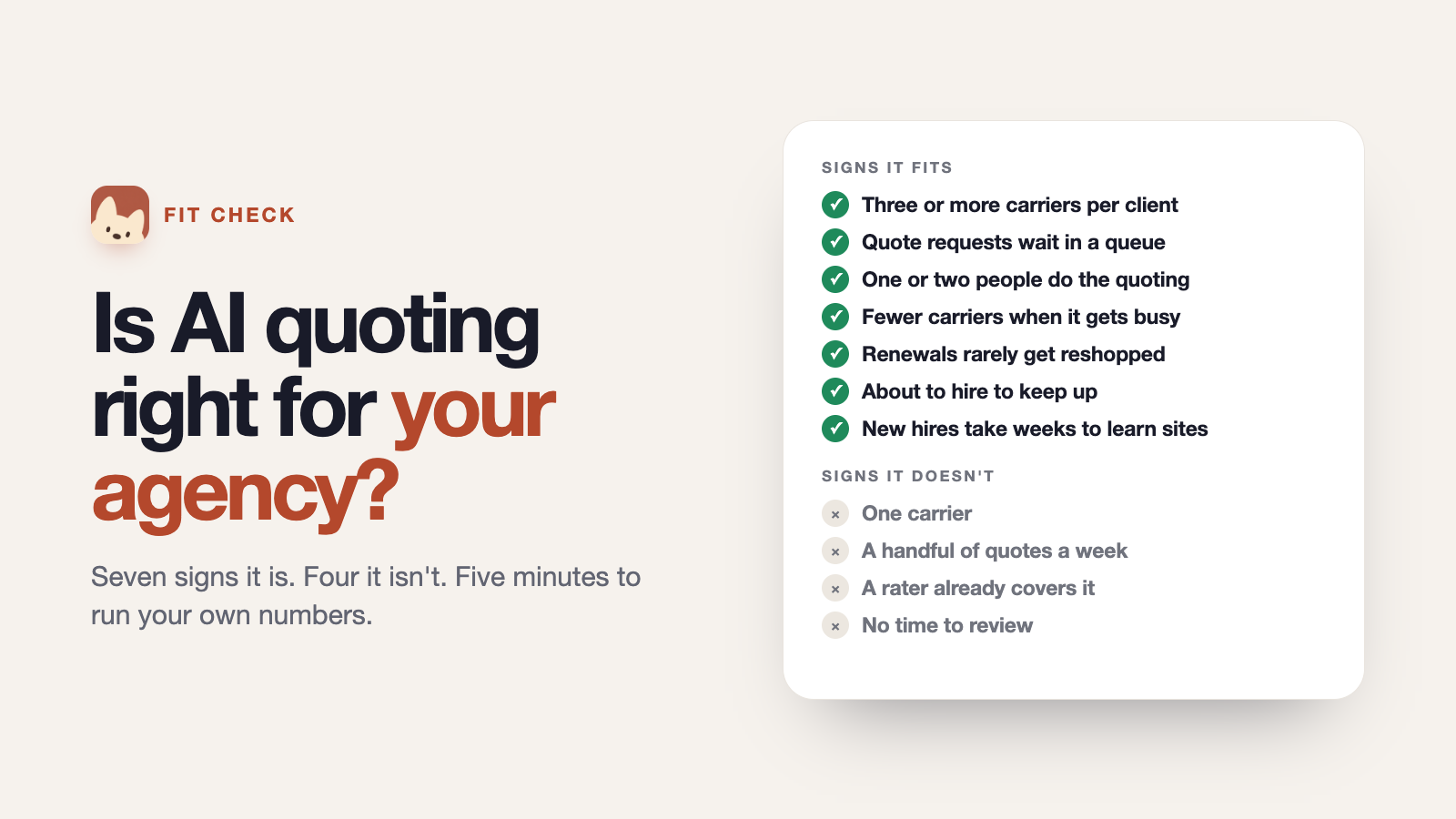
Seven signs it fits
The more of these that sound like your agency, the more likely it pays off.
1. You quote most clients with three or more carriers. The time saved grows with each extra carrier, because the work being removed is the repeated entry.
2. Quote requests wait in a queue. If a request that arrives at 10 a.m. is often not started until the next day, the limit is entry time, and that is the thing this fixes.
3. One or two people do nearly all the quoting. When they are out, quoting stops. When they are busy, it slows. A tool that does the entry takes the pressure off the people you can least afford to lose.
4. You quote fewer carriers when it gets busy. Be honest about this one. If a busy Tuesday means the client gets two carriers when you could have run five, clients are seeing fewer options than your appointments allow.
5. Renewals only get reshopped when a client complains. Most agencies would remarket more renewals if it did not mean entering the client again from the start.
6. You are about to hire to keep up with quoting. A person brings judgment, relationships and service. If the reason for the hire is mostly typing into carrier sites, compare the two first. We wrote up hiring a CSR or adding Relay as fairly as we could.
7. A new hire takes weeks to learn where each carrier puts each question. That learning curve is mostly about websites, and very little of it is about insurance.
Four signs it does not
1. You write with one carrier, or nearly always the same one. There is no repeated entry to remove. This is built for independent agencies with several appointments.
2. You quote a handful of times a week. The arithmetic below will show a small number. A better intake form will probably do more for you. Start with the quote-ready intake checklist.
3. A comparative rater already covers your carriers and lines well. If one entry in your rater returns bindable quotes from the carriers you actually place with, keep using it. AI quoting earns its place on the carriers and lines your rater does not reach, or where its numbers do not match the carrier's own site. We compare the two in AI or a comparative rater.
4. You want something that works without review. Every result needs a licensed person to look at it before it reaches a client. If nobody on the team has time to review, faster quoting will only move the pile.
One more that is not a "no" but a "not yet": if the slow part is getting information out of clients, fix that first. No tool can quote a client whose roof year nobody has asked for.
Run your own numbers in five minutes
Count from one ordinary week. Rough figures are fine.
| Line | Your number |
|---|---|
| A. New quotes and remarkets per week | |
| B. Carriers you enter for a typical client | |
| C. Minutes of entry per carrier | |
| D. Hours of entry per week (A × B × C ÷ 60) |
Here is a worked example with made-up numbers, to show the shape. An agency does 30 quotes a week, enters 4 carriers each, at 15 minutes per carrier. That is 30 × 4 × 15 ÷ 60 = 30 hours of entry a week. Your numbers will differ, which is the point of counting them.
Line D is the most a tool can give back. You will not get all of it, because someone still gathers the information and reviews the results. Compare what is left with the cost of the tool, and with what your team would do with those hours.
If you want the arithmetic done for you, use the quoting cost calculator. The manual quoting cost worksheet goes into more detail on how to count a week.
What agencies have measured with Relay
These are the figures we can stand behind. Each is one team's or one run's result. None is an average or a promise.
- 1 → to 10quote packets an hour, per quoterOne agency team, before and after Relay.
- 20quotes in two hours, by a new hire on day oneOne agency team, September 2026.
- 1 hr 40 → to 8 minone commercial file, start to finishOur own run, measured once, September 2026.
Every measured figure, with how each was counted, is on our results page.
What Relay does not do
You should hear this from us before a call, not after.
- It does not bind, sign, take payment or talk to your clients. Those stay with your licensed staff.
- It does not guess. A missing answer stays blank until your team fills it in.
- It does not remove review. Every result comes back for a person to check.
- It does not replace your management system. Relay works alongside the AMS you already use, and your client records stay where they are. During setup we show you how to get results into it.
- It does not work without your access. It runs the carriers your team can sign in to, under your own logins, and stops for MFA and CAPTCHAs so a person can complete them.
More detail is on the security and control page.
If the signs point to yes
The next step is a 30-minute call. We look at how you quote today, show Relay running a sample quote, and pick the work to start with. If it is not a fit, we will say so on the call.
Here is how starting works after that:
- Day one, about 60 minutes. We set up your carriers together and run one of your own submissions.
- That week. Your team runs the next ones, with us a message away.
On price: it is one flat rate for the platform, with no charge for usage, sized to your agency on the call. The pricing page explains how it works.
To get the most from the call, bring your line D number and the names of the carriers you quote most. Before your call has the short list.
Common questions
How many quotes a week makes this worth it?
There is no single threshold, because it depends on how many carriers you enter and how long each takes. Use line D. If entry is a few hours a week, it is probably not your biggest problem. If it is a day or more of someone's week, it is worth a call.
We already have a rater. Do we need both?
Possibly. Many agencies use a rater for the carriers and lines it covers and still enter the rest by hand. List the carriers you typed into last week. Those are the ones to ask about.
Which carriers does Relay work with?
Any carrier your team can sign in to. You need an appointment and a portal login with the carrier. We set them up with you on day one.
Can we try it on our own work first?
On day one we run one of your own submissions with you, so the first thing you see after the call is your own client, your own carriers and a real result.
What if my team is not technical?
The request is written in ordinary words and the work happens in a window you can watch. If your team can use a carrier website, they can use this.
What to do next
Fill in the four lines on the worksheet. If line D is large and three or more of the seven signs sound familiar, book the call and bring the number with you.
Three or more signs sound familiar? Book a 30-minute call and watch Relay quote your carriers.
 From Relay, by email